
New permitted development rights could make EV charging easier for homes without off-street parking
There has been plenty of discussion about making EV charging easier for people who do not have a private driveway. Now, there is more concrete development to report.
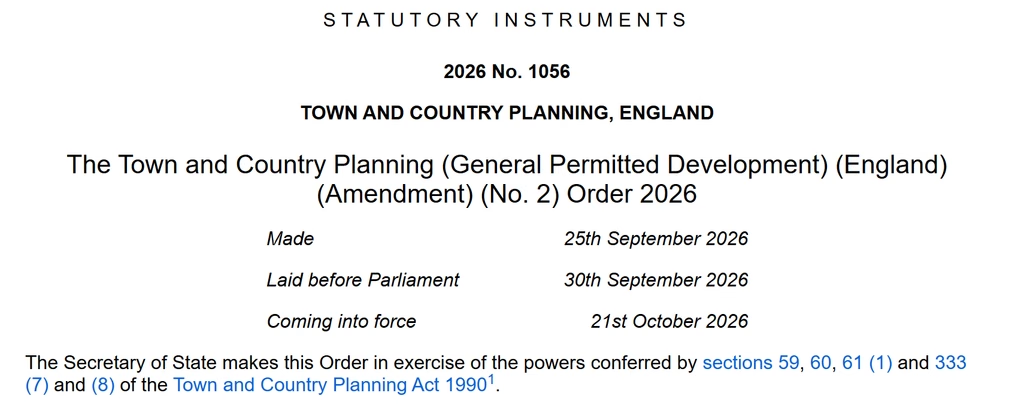
The Government has made new changes to England’s permitted development rules for electric vehicle charging. The Town and Country Planning (General Permitted Development) (England) (Amendment) (No. 2) Order 2026 was made on 25 September and is due to come into force on 21 October 2026.
For London drivers, the change is particularly interesting because it moves the issue beyond consultation and proposals and into new planning rules that installers, homeowners and local authorities will need to work with.
What is changing for EV charging?
One of the most important changes concerns properties where the car is parked on the road rather than on a driveway.
The new rules expand permitted development rights for certain domestic EV charge points. They also introduce a specific permitted development right for cross-pavement solutions.
In practical terms, this means a charging cable can be routed from a home towards a vehicle parked on the street using a pavement-embedded cable channel, rather than simply leaving a cable trailing across the pavement.
That distinction matters.
A cable running loosely across a public footway can create an obvious trip hazard and can cause problems for pedestrians, wheelchair users and people with visual impairments. The new approach is intended to provide a safer and more controlled way of connecting homes with on-street parking to EV charging.
Does this mean anyone can install a cable across the pavement?
No.
This is an important point for homeowners considering an EV charger installation.
The new permitted development rights do not mean that a homeowner can simply cut into a pavement and install their own cable channel.
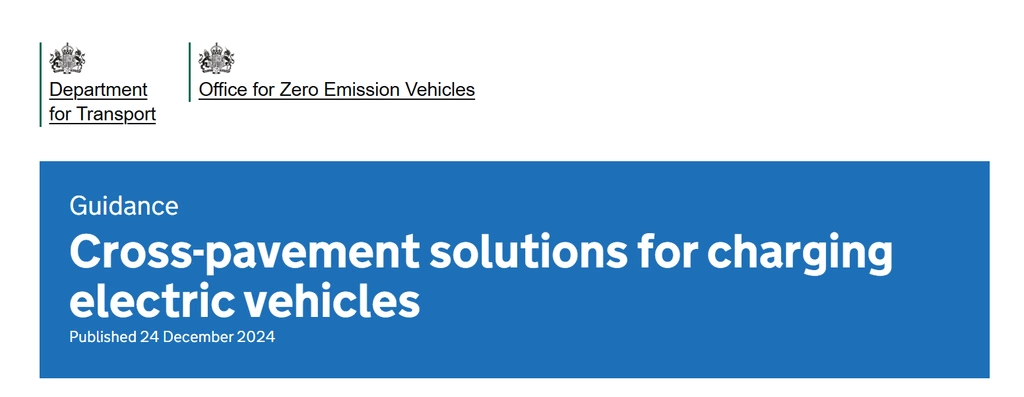
The legislation defines an authorised cross-pavement solution as one installed by, on behalf of, or with the authorisation of the relevant highway authority.
So, although planning permission is being streamlined, there are still requirements relating to the highway and the installation itself.
Local authorities therefore continue to have an important role in deciding how cross-pavement charging is delivered on their roads.
What does this mean for London homeowners?
For homeowners with a driveway, garage or private parking space, the usual home charger installation process remains the straightforward option.
The bigger potential benefit is for people who own or rent an EV but have no off-street parking.
London has many streets where properties have limited front gardens, terraced housing or no practical space to park a car away from the road. For these households, access to convenient home charging has always been more complicated.
The new rules could help make a properly designed charging arrangement more achievable.
However, homeowners should not assume that every property will qualify automatically. Conservation areas, listed buildings, pavement layouts, highway restrictions and the individual circumstances of a property can all affect what is possible.
Larger EV charging installations are changing too
The October changes are not only about residential charging.
The legislation also makes changes affecting equipment housing associated with EV chargepoints in non-domestic areas. The cumulative maximum volume for certain equipment housing can increase to 45 cubic metres, with additional conditions applying in some circumstances.
This is relevant to larger commercial charging projects where chargers require additional electrical equipment, control systems or other infrastructure.
For businesses planning workplace charging, fleet charging or larger EV installations, this is another reason to consider the wider electrical and planning requirements at the design stage rather than treating the chargepoint itself as the whole project.
What should EV owners do now?
If you are considering a home EV charger in London, there is no reason to wait until 21 October simply because the new rules are coming into force.
The right installation route depends on your property, parking arrangements and the local authority requirements.
If you have private parking, a dedicated home chargepoint can normally provide the simplest and most convenient way to charge overnight.
If your vehicle is normally parked on the street, the situation needs more careful consideration. A professional installer can look at the property, cable route, electrical supply and the practical requirements before you commit to an installation.
For commercial premises, the same principle applies. Charger numbers, available electrical capacity, load management, cable routes and any required DNO or planning considerations should be considered together.
A useful step forward for EV charging
The October 2026 changes will not solve every problem faced by London EV drivers, particularly those relying on on-street parking. But they are a significant step towards making home charging more practical for households that previously had limited options.
The important change is that the Government is now putting a formal planning framework around cross-pavement charging rather than leaving homeowners and councils to work around the previous restrictions.
As the rules come into force, the focus will shift from whether these changes are coming to how they are actually implemented on London’s streets.
If you are looking at installing an EV charger at home, in a flat, workplace or commercial property, getting the installation assessed properly is still the best place to start.